Data-Driven NBA Betting Intelligence
NBA Games Betting: The Data-Driven UK Punter’s Guide
 Available in US
Table of Contents
- Why UK Punters Are Turning to NBA Courts
- The Five Numbers That Shape This Guide
- The UK NBA Betting Market in Numbers
- Core NBA Bet Types Every Punter Needs
- Building a Data-Driven NBA Betting Approach
- Bet the schedule, not just the teams
- NBA Betting Integrity: What the Data Shows
- Watching NBA in the UK: The $77 Billion Media Deal
- Responsible NBA Betting: UK Tools and Limits
- Frequently Asked Questions
Data-driven NBA betting intelligence for UK punters
By NBA Betting Analyst

Why UK Punters Are Turning to NBA Courts
Nine years ago, I placed my first NBA bet from a flat in Manchester. The Cavaliers were hosting the Warriors in an early-season tilt, and I had no idea how to read an American spread. I treated it like a football handicap, got the conversion wrong, and lost a tenner before tip-off. That stumble taught me more about NBA wagering than any bookmaker’s FAQ page ever would — and it set me on a path I’m still walking today.
The UK NBA betting landscape has changed beyond recognition since that night. Online gambling revenue in the UK hit 7.8 billion pounds in gross gambling yield for the 2024-25 period — a 13.1% jump year on year — and basketball is riding that wave harder than most punters realise. Seven percent of UK internet users now watch the NBA, and 77% of basketball fans in Britain follow the league specifically. That is not a niche audience anymore. It is a market.
What is driving the shift? A younger demographic, for one — 57% of NBA viewers in the UK are under 35, the youngest fan profile of any major sport tracked across comparable markets. They grew up streaming highlights on phones, not waiting for Match of the Day. They think in decimals, not fractions. And they want more than a “bet now” button — they want to understand why a line sits where it sits, what the numbers actually mean, and how to avoid the traps that drain a bankroll before the All-Star break.
This guide is built for that audience and anyone else willing to treat NBA betting as a discipline rather than a lottery. I have spent nearly a decade dissecting lines, tracking schedule spots, and cross-referencing advanced stats with bookmaker pricing across the UK market. What follows is the framework I use every season — no promotional codes, no “best bookmaker” rankings, just the data and the method.
Before we get into the detail, here is a quick snapshot of what this guide covers and why it matters.
The Five Numbers That Shape This Guide
- The UK online gambling sector generated 7.8 billion pounds in GGY in 2024-25, with sports betting accounting for 56.6% of the market — and NBA is the fastest-growing segment among under-35 punters.
- Only 19% of NBA games remain within 10 points entering the fourth quarter, meaning spread and total settlement is effectively decided before the final period in most contests.
- Sportradar flagged 233 suspicious basketball matches in 2025, with 49% linked to totals markets — a data point that should inform your market selection.
- Amazon Prime Video now broadcasts 20+ NBA regular-season games in the UK per season under the new $77 billion media deal, expanding legal live viewing options for in-play bettors.
- 78% of micro-sports in-play bettors show problem gambling patterns — making deposit limits and session controls essential, not optional, for anyone wagering on live NBA action.
The UK NBA Betting Market in Numbers
I track a spreadsheet of UK gambling data the way some people track fantasy rosters — obsessively, quarterly, with colour-coded tabs. The picture it paints right now is stark: this market is growing fast, and basketball is one of the engines.
UK Gambling Industry GGY
16.8 billion pounds (April 2024 — March 2025), up 7.3% year on year
Online Sector GGY
7.8 billion pounds for remote casino, betting, and bingo combined
UK Online Sports Bettors
10% of the adult population place online sports bets
Sports Betting Share
56.6% of the UK online gambling market by game type
Those headline numbers matter because they set the stage for where basketball sits inside the broader ecosystem. Sports betting accounts for 56.6% of the entire UK online gambling market — more than casino, poker, and bingo combined. Within that, football dominates at roughly 35% of global sports betting handle. But the gap is closing. In the US, basketball already claims around 28% of total sports wagering volume, and as UK punters gain access to more NBA coverage — a point I will return to when we discuss the new media deal — that proportion is creeping upward on this side of the Atlantic.
The UK sports betting market is projected to reach $21.3 billion by 2030, growing at a compound annual rate of 11.4%. Europe as a whole holds the largest regional share of the global sports betting market at nearly 44%. The infrastructure is here. The regulatory framework is here. The audience is here. What has been missing, in my experience, is informed content that helps UK punters navigate NBA markets with the same rigour they apply to Premier League football.
Every month, UK punters place 290.03 million online bets on real sporting events. That is roughly 9.7 million bets per day — and the NBA regular season alone offers 1,230 games across six months of action.
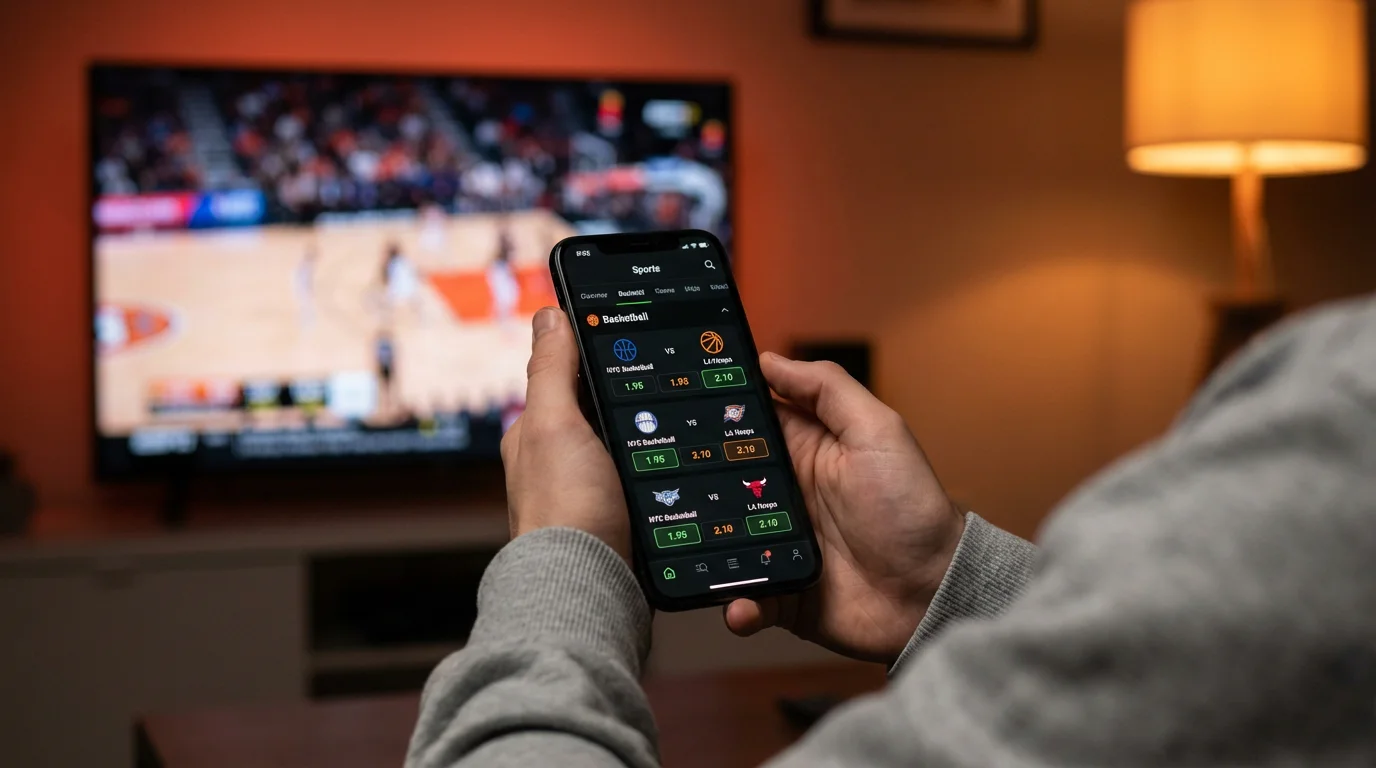
The demographic data reinforces why NBA betting is not a passing trend. The 18-24 age group leads mobile gambling adoption in the UK at 76%, and the NBA’s under-35 viewer skew aligns almost perfectly with that cohort. These are digital-native punters who research on their phones, bet on their phones, and expect the platforms they use to keep up. Understanding who is in this market — and why they are here — shapes every strategic decision that follows in this guide.
Core NBA Bet Types Every Punter Needs
The first time a UK football punter opens an NBA betting page, the terminology alone can feel like a foreign language. Moneyline, spread, totals, props — some of these have direct equivalents in football betting, and some do not. I spent my first full season confusing “covering the spread” with “winning outright” and burning units in the process. Let me save you that tuition fee.
The NBA betting market is one of the deepest and sharpest in the world. The variety of available wagers dwarfs what you will find in most UK sports, and the lines are set by some of the most sophisticated pricing operations in the industry. That depth is an advantage if you know what you are doing — it means more angles, more value pockets, and more ways to express an opinion on a game.
The five core bet types below form the foundation. Every strategy I discuss later in this guide builds on these fundamentals, so take the time to understand not just what each bet is, but how bookmakers price it and where the edges tend to appear.
Moneyline
Pick the outright winner. No spread, no handicap. The simplest NBA wager and often the most overlooked by experienced punters chasing complexity. Favourites carry short odds; underdogs offer higher returns but win less frequently. Works best when you have a strong view on the game outcome but not the margin.
Spread (Handicap)
The bookmaker assigns a point advantage to the underdog and a corresponding deficit to the favourite. You are not betting on who wins — you are betting on whether a team covers the margin. A -6.5 spread means the favourite must win by seven or more. This is the bread-and-butter NBA market, and the one I spend the most time analysing.

Beyond moneyline and spread, the three other pillars of NBA wagering are totals (over/under on combined points), player props (individual performance bets), and futures (long-range markets like championship winner or MVP). Each operates on different information, rewards different research habits, and carries different risk profiles.
Totals (Over/Under) — a bet on whether the combined score of both teams will finish above or below a number set by the bookmaker. Typical NBA game totals range from 210 to 240, depending on the teams’ pace and defensive efficiency.
Player Props — wagers on individual stat lines: points scored, rebounds, assists, three-pointers made, and combinations thereof. Props have exploded in popularity because they let you isolate a single player’s performance from the chaos of the team result.
Futures — bets placed on outcomes that will not be settled for weeks or months. NBA Championship winner, conference winners, MVP, and other awards. These reward patience and early-season identification of value.
Each of these five types gets dedicated coverage in the cluster guides linked below. What matters at this stage is understanding how they relate to each other. A sharp punter does not pick one market and ignore the rest — they read the moneyline to gauge relative strength, check the spread to understand the bookmaker’s expected margin, look at the total to assess the projected pace, and then decide where the mispricing is most likely to sit.
| Market | Selection | Odds (Fractional) | Odds (Decimal) |
|---|---|---|---|
| Moneyline | Team A to Win | 4/9 | 1.44 |
| Spread | Team B +6.5 | 10/11 | 1.91 |
| Total | Over 224.5 | 10/11 | 1.91 |
| Player Prop | Player X Over 25.5 Points | 5/6 | 1.83 |
Reading NBA Odds in Fractional and Decimal
Here is the thing that trips up most UK punters coming from football: NBA odds originate in the American format — those plus and minus numbers you see on US sportsbooks — and then get converted to fractional or decimal for the UK market. The conversion is not always clean, and understanding how it works gives you an edge in spotting pricing discrepancies.
Fractional odds, the traditional UK format, express profit relative to stake. If you see 5/2, you stand to collect five pounds of profit for every two pounds wagered, plus your stake back. Decimal odds fold the stake into the number: the same bet reads 3.50 in decimal, meaning a one-pound bet returns 3.50 pounds total. Most UK bookmakers default to fractional, but I recommend switching to decimal for NBA betting — it makes comparing lines across platforms faster and calculating implied probability more intuitive.
| American | Fractional | Decimal | Implied Probability |
|---|---|---|---|
| -150 | 2/3 | 1.67 | 60.0% |
| +130 | 13/10 | 2.30 | 43.5% |
| -110 | 10/11 | 1.91 | 52.4% |
| +250 | 5/2 | 3.50 | 28.6% |
Converting American Odds to Decimal
For negative American odds (favourites): Decimal = 1 + (100 / absolute value). Example: -150 becomes 1 + (100 / 150) = 1.667.
For positive American odds (underdogs): Decimal = 1 + (American odds / 100). Example: +130 becomes 1 + (130 / 100) = 2.30.
To get implied probability from decimal odds: Probability = 1 / Decimal Odds. Example: 1.91 gives 1 / 1.91 = 0.524, or 52.4%.
The gap between the implied probabilities of both sides of a market — the overround — is the bookmaker’s margin. A two-way NBA moneyline market with fair odds would add up to exactly 100%. In practice, the combined implied probability typically lands between 104% and 108%. Knowing how to calculate that margin is the first step toward identifying when one side of the market is priced more favourably than it should be.
Spread Betting at a Glance
Spread betting — called handicap betting in UK football markets — is the most heavily wagered NBA market. The bookmaker sets a point margin, and you bet on whether the favourite will win by more than that margin (cover the spread) or whether the underdog will lose by less than it (or win outright). Half-point lines like -6.5 eliminate the possibility of a push, where the margin lands exactly on the number.
Key numbers in NBA spreads carry outsize importance. Certain margins — 3, 5, 7 — occur more frequently than others due to the scoring structure of basketball (two-point baskets, three-pointers, and free throws). When a line sits at one of these thresholds, the difference between -6.5 and -7.5 can significantly affect your expected hit rate. Understanding which numbers matter and when to shop for half-point moves is a skill that separates break-even punters from profitable ones.
If spread betting is where you plan to concentrate your NBA research, the full spread betting guide breaks down ATS records, key numbers, worked examples in fractional odds, and the most common mistakes I see UK punters making in this market.
Spreads test your read on the margin. Player props test your read on individuals.
Player Props at a Glance
Player proposition bets isolate individual performance from the team result. You wager on whether a player will go over or under a specified stat line — points scored, rebounds collected, assists delivered, or combinations of these. The market has grown faster than any other NBA betting segment because it rewards granular research: understanding a player’s usage rate, minutes projection, and matchup context gives you information the casual bettor lacks.
The trap with props is correlation. Two props on the same player or the same game are rarely independent events, and treating them as such — especially in same-game parlays — leads to mispriced risk. I walk through stat-based selection methods and correlation pitfalls in the player props strategy guide.
Props are a pre-game market. Live betting flips the script entirely.
Live Betting at a Glance
In-play betting lets you wager on NBA games while they are in progress. Lines update continuously — sometimes every possession — reflecting score changes, momentum shifts, and injury developments in real time. For UK punters watching a late-night game, live betting turns passive viewing into active engagement. It also turns discipline into the most important variable in your process.
The speed of NBA scoring creates unique in-play dynamics. A 12-0 run can flip a spread in under three minutes. The punters who profit from live betting are not the ones chasing momentum — they are the ones who identified a pre-game thesis and wait for the live market to offer a better entry point. The live betting strategy guide covers quarter-by-quarter patterns, timeout windows, and why the discipline problem is the real opponent in this market.
Live betting operates on minutes. Futures operate on months.
Futures and Outrights at a Glance
Futures markets let you bet on outcomes that will not be decided for weeks or months: NBA Championship winner, conference titles, MVP awards, and other season-long results. The prices are longest in the preseason, when uncertainty is highest, and shorten as the field narrows. Patient punters who identify value early and hedge at the right moments can extract returns that game-by-game betting rarely matches.
The NBA Cup — the in-season tournament introduced in the 2023-24 season — added a new futures dimension. It creates a separate competitive bracket within the regular season, with its own outright market and game-by-game spreads. The futures and outrights guide covers championship pricing, award markets, and timing strategies for UK punters.
Futures are single-outcome bets with long timelines. Accumulators compress multiple outcomes into one.
Accumulators and Parlays at a Glance
An accumulator — called a parlay in American terminology — combines multiple selections into a single bet. All legs must win for the bet to pay out, and the odds multiply together. A four-leg acca at 1.90 per leg returns roughly 13/1, which looks attractive until you calculate the implied hit rate. The maths works against you more aggressively than most punters expect, and bookmakers know it — accumulators are among the highest-margin products they offer.
Same-game parlays, where all legs come from a single contest, have become the most promoted NBA product at UK bookmakers. They carry additional risk because the selections are often correlated in ways the pricing does not fully account for. The accumulator strategy guide breaks down correlation rules, leg selection frameworks, and the bankroll discipline that keeps multi-bet strategies from spiralling.
Knowing the bet types is the vocabulary. Strategy is the grammar.
Building a Data-Driven NBA Betting Approach
I lost money in my first three NBA seasons. Not catastrophic amounts, but enough to know that my process was broken. The turning point was not a single winning bet — it was the week I stopped guessing and started building a pre-bet checklist that forced me to justify every wager with data before placing it. That checklist has evolved over the years, but its purpose has not: slow me down, filter out noise, and only let through bets where the numbers support the position.
Data-driven NBA betting is not about building a supercomputer or subscribing to expensive prediction models. It is about asking the right questions before every bet and knowing where to find the answers. Academic research backs this up in ways that no competitor in the UK betting space bothers to cite. A study by Wang and colleagues analysed 2,295 NBA games over ten years and found that only 19% remain within 10 points entering the fourth quarter. That means four out of five games are effectively decided by the final period — which has massive implications for spread pricing, live bet timing, and total settlement.
Separately, Garcia and colleagues established that physical performance declines across the course of an NBA game with an effect size of -1.27 between the first and fourth quarters. Players are measurably slower, less explosive, and less accurate as the game progresses. If you are not factoring fatigue into your analysis — within a game and across the schedule — you are ignoring one of the most well-documented variables in basketball performance research.
Pre-Bet Checklist: Seven Questions Before Every NBA Wager
- What is the injury report, and has it been reflected in the current line?
- Is either team on a back-to-back or in a compressed schedule spot?
- Where has the line moved since opening, and in which direction?
- Does the total align with both teams’ pace and defensive efficiency ratings?
- Am I betting on information or on a feeling?
- Does this bet offer positive expected value based on my probability estimate?
- What percentage of my bankroll does this wager represent?
Do
- Compare lines across at least three UK bookmakers before placing a bet
- Wait for official injury reports rather than acting on social media rumours
- Track your bets with a spreadsheet recording odds, stake, result, and reasoning
- Set a daily and weekly loss limit and stick to it regardless of perceived opportunities
Don’t
- Chase losses by doubling stakes after a losing run
- Bet every game on the slate — selectivity is the foundation of edge
- Ignore the total when analysing a spread, or vice versa — they are connected markets
- Treat accumulators as your primary betting strategy — the maths works against you compounding

Bet the schedule, not just the teams
Away team
Home team
Schedule Spots and Back-to-Back Fatigue
If I had to pick one factor that UK punters consistently underweight, it would be schedule context. Not “who is playing who” — that is the obvious part. I mean the when: is this team playing the second game of a back-to-back? Did they fly across three time zones last night? Are they sandwiched between two rivalry games and likely to rest key rotation players?
NBA players require 48 to 72 hours for full glycogen replenishment after a high-intensity game. When a team plays two games in consecutive nights, that recovery window is compressed to roughly 18-20 hours — less than half the minimum optimal threshold. The performance decline is not theoretical. It is measurable, consistent, and frequently underpriced in the market.
The Garcia et al. research I mentioned earlier quantified a within-game performance decline of -1.27 from the first to the fourth quarter. Now compound that with an overnight turnaround. Teams on the second night of a back-to-back, particularly on the road, show a widened spread against rested opponents — but not always by enough. This is where value lives for punters willing to dig into the schedule data and cross-reference it with ATS performance trends.
The NBA regular season compresses 1,230 games into roughly 177 days. Every team plays 82 games, and back-to-back sets are unavoidable — typically 12-15 per team per season. Each one is a data point. Each one is an opportunity.
Reading Line Movement and Sharp Money
An NBA line is not a prediction. It is a price. And like any price in a liquid market, it moves in response to supply and demand. When a line opens at -4.5 and closes at -6, something happened between those two numbers — and understanding what happened is more valuable than knowing the final number itself.
Sharp money — large wagers placed by professional bettors or syndicates that bookmakers respect enough to move the line in response. When sharp action hits one side, the line shifts even if public volume favours the other side. This creates what is called reverse line movement — the line moves against the weight of public bets.
Sportradar’s Universal Fraud Detection System monitors 30 billion odds changes annually across more than 600 bookmakers worldwide. That infrastructure exists for integrity purposes, but it also highlights how dynamic the NBA betting market is. Lines are not static — they are living documents that reflect every injury report, every sharp wager, and every shift in public sentiment between the moment they open and the moment the ball is tipped.
Reading a Line Move: A Practical Example
Opening line: Team A -3.5 (10/11). By mid-afternoon, the line moves to Team A -4.5 with no injury news. This signals sharp action on Team A — professional money believes the margin will exceed 3.5. If you agreed with the sharp side pre-open, the value has now diminished. If you preferred Team B, the extra point in your favour might represent a better entry.
Key question: did the total move alongside the spread? If the total stayed flat while the spread widened, the sharp view is specifically about margin, not about the overall scoring pace. These nuances matter.
Understanding steam moves, syndicate action, and reverse line movement is a discipline unto itself — one that rewards patience and pattern recognition over speed.
NBA Betting Integrity: What the Data Shows
Nobody in the UK betting content space talks about match-fixing in basketball. I find that remarkable, given the data. It is the elephant in the arena, and pretending it does not exist does not make your bets safer — it makes you less informed.
Sportradar flagged 233 suspicious basketball matches in 2025, making the sport the second most affected globally behind football’s 618 cases. Their monitoring covered more than one million events across 70 sports that year, identifying 1,116 suspicious matches in total — with over 99.5% of all monitored events showing no irregularities. The numbers suggest the problem is real but contained, not endemic.
Suspicious Basketball Matches
233 flagged globally in 2025, second only to football
Most Affected Market
49% of suspicious basketball activity linked to totals (over/under), 35% to spreads
AI Detection Growth
Sportradar’s UFDS system detected 56% more suspicious matches year on year through AI-driven analysis
North America
84 suspicious matches in 2025 — nearly double the previous year

The breakdown by market type is what I find most relevant to everyday punters. Nearly half of suspicious basketball activity is concentrated in totals betting — over/under markets. Another 35% involves spreads. Moneyline markets, by contrast, are harder to manipulate because they require controlling the outright result rather than influencing the margin or pace. If integrity concerns factor into your risk management — and they should — this distribution is worth internalising.
Andreas Krannich, Sportradar’s Executive Vice President for Integrity Services, has described the relative stabilisation of suspicious match numbers as encouraging but has stressed that match-fixing remains an evolving threat requiring sustained investment in technology, intelligence, education, and collaboration. The 56% increase in AI-detected suspicious activity suggests the detection tools are improving faster than the manipulation techniques — but complacency is the real risk.
The 2025 NBA gambling scandal — involving federal charges against 34 individuals including active and former players — put integrity in the spotlight for American media. For UK punters, the lesson is not to panic. It is to diversify your market exposure, be cautious with totals in lower-profile matchups, and understand that the monitoring infrastructure, while imperfect, is more advanced than at any point in the sport’s history. The four major US sports leagues now collectively earn an estimated $4.2 billion from legal sports betting, which gives them a powerful financial incentive to protect the product’s credibility. As one industry analyst put it, people have to have faith in the product — they have to believe the players, the coaches, and the referees are on the level.
Watching NBA in the UK: The $77 Billion Media Deal
Three years ago, watching NBA games legally in the UK meant choosing between Sky Sports’ limited schedule and NBA League Pass’ blackout-heavy subscription. The landscape has fundamentally changed, and the catalyst is a media deal so large it makes the Premier League’s domestic rights look modest by comparison.
The NBA signed an 11-year media agreement worth $77 billion with Disney, NBCUniversal, and Amazon, effective from the 2025-26 season. For UK punters, the Amazon component matters most: Amazon Prime Video will broadcast a minimum of 20 additional regular-season games in the UK and Ireland each season. That is 20 more opportunities to watch live NBA action on a platform millions of UK households already subscribe to — without an additional sports package or a separate League Pass subscription.
The number of free-to-air NBA games is also expanding under the new deal, rising from a minimum of 15 to approximately 75 per season across broadcast partners. While most of that increase is US-focused, the broader availability of content feeds into international coverage, highlights packages, and the general visibility that drives UK interest in the sport.

The viewership data already reflects this momentum. NBA viewership rose 30% in the first month of the 2025-26 season compared to the year prior — the highest opening-month audience since 2017. Total league revenue has grown 76% since 2020, reaching $11.3 billion. That growth funds better broadcast production, more international investment, and the kind of data infrastructure that makes NBA one of the most transparent sports in the world for bettors who know where to look.
The $77 billion media deal works out to roughly $7 billion per season — more than the total annual revenue of many professional sports leagues worldwide. It guarantees NBA coverage will be broadly accessible in the UK for at least the next decade.
For UK punters who want to bet on live NBA action, understanding the broadcast landscape — platform options, subscription costs, blackout rules, and UK-friendly scheduling — is now a practical prerequisite rather than a nice-to-have.
Responsible NBA Betting: UK Tools and Limits
I have a rule that I never break: if a guide about betting does not include a section on responsible gambling, it is not a guide — it is an advertisement. The UK has some of the most robust player protection tools in the world, and using them is not a sign of weakness. It is part of the process.
The Gambling Commission reports that 0.5% of UK gamblers fall into the high-risk problem gambling category. That sounds small until you remember the scale of the market — with 10% of the population betting on sports, that 0.5% represents tens of thousands of people. The economic cost of gambling harm in the UK runs between 260 million and 1.2 billion pounds annually, depending on the methodology used to calculate it.
One statistic should give every in-play bettor pause: 78% of people engaged in micro-sports in-play betting — the rapid, event-by-event wagering that NBA’s fast pace encourages — have been found to suffer from problem gambling. Live NBA betting, with its constant action and late-night UK time slots, sits squarely in this high-risk category. Discipline is not optional here. It is a survival mechanism.
UK bookmakers licensed by the Gambling Commission are required to offer deposit limits, loss limits, session time reminders, and cooling-off periods. GAMSTOP provides a national self-exclusion scheme that covers all UKGC-licensed online operators. If you set a GAMSTOP exclusion, every licensed bookmaker in the UK will block your access for the period you choose — six months, one year, or five years. There is no way around it, which is precisely the point.
Do
- Set a monthly deposit limit with every bookmaker you use before placing your first bet
- Use reality check reminders — most UK platforms let you set alerts at 30, 60, or 90-minute intervals
- Keep a separate bank account or e-wallet for betting funds, completely isolated from household finances
- Talk to GamCare (0808 8020 133) or use the National Gambling Helpline if betting stops feeling like a choice
Don’t
- Bet with money allocated for rent, bills, or essential expenses — not even “just this once”
- Increase stakes to recover losses — this is the single most reliable path to a blown bankroll
- Bet on NBA live markets while tired, intoxicated, or emotionally compromised after a losing run
- Dismiss gambling harm as something that only affects “other people” — the data says otherwise
One hundred and ninety thousand children in the UK are either suffering from or at risk of problem gambling. That number alone justifies every protective measure the industry has implemented and every one it has yet to adopt. Responsible betting is not a disclaimer I bolt onto the end of a guide. It is the foundation on which everything else in this guide sits.
Frequently Asked Questions
Is NBA betting legal in the UK?
Yes. Betting on NBA games is fully legal in the UK when done through bookmakers licensed by the UK Gambling Commission under the Gambling Act 2005. The Act regulates all forms of remote gambling offered to UK residents, and any operator accepting NBA bets from UK punters must hold a valid UKGC licence. You can verify a bookmaker’s licensing status directly on the Gambling Commission’s public register. Winnings from NBA bets are tax-free for UK punters — the tax obligation falls on the operator, not the bettor.
What are the most popular NBA bet types for UK punters?
The five core markets are moneyline (picking the outright winner), spread or handicap (betting on the margin of victory), totals or over/under (combined points), player props (individual stat lines), and accumulators or parlays (multi-leg bets). Moneyline and spread dominate single-bet volume, while same-game parlays have become the fastest-growing product due to heavy promotion by UK bookmakers. Player props are increasingly popular among punters who prefer researching individual matchups over team outcomes. Each market rewards a different type of analysis, and the most effective approach combines insights across several of them rather than specialising in just one.
How do NBA odds work in the UK?
UK bookmakers display NBA odds in either fractional or decimal format. Fractional odds like 5/2 express the profit relative to your stake — a 10-pound bet at 5/2 returns 25 pounds profit plus your 10-pound stake. Decimal odds like 3.50 represent the total return per pound wagered, so a one-pound bet returns 3.50 total. NBA odds originate in the American format (plus and minus numbers) and are converted for the UK market. I recommend using decimal odds for NBA betting because they simplify implied probability calculations and make cross-platform comparison faster. To calculate implied probability from decimal odds, divide 1 by the decimal number — odds of 1.91 imply a 52.4% probability.
When is the best time to place NBA bets?
The optimal timing depends on the market and your thesis. Opening lines — typically posted 12-18 hours before tip-off for regular-season games — tend to offer the most value for punters who have done early research, because fewer bettors have acted on injury reports and lineup news at that stage. Closing lines are generally the sharpest, meaning they most accurately reflect the true probability of each outcome. For UK punters, the time zone creates a practical consideration: most NBA injury reports are confirmed between 5:30 PM and 7:30 PM Eastern Time, which translates to 10:30 PM to 12:30 AM GMT. If you are betting on tonight’s slate, checking lines after the injury reports land but before tip-off is the window that combines the most information with available odds.
Does overtime count in NBA bets?
It depends on the bet type. Moneyline, spread, and full-game total bets all include overtime in their settlement — whatever the final score is after any overtime periods, that is the result your bet is graded on. Quarter bets, half bets, and race-to markets are settled based on the score at the end of the relevant period, with overtime excluded. This distinction catches many UK punters off guard, particularly those coming from football where extra time rules are more consistently communicated. Always check the specific settlement terms in your bookmaker’s rules, as wording can vary slightly between operators.
What is spread betting in the NBA?
Spread betting — the NBA equivalent of handicap betting in UK football — involves a point margin set by the bookmaker. The favourite is assigned a negative spread (e.g., -6.5), meaning they must win by seven or more points for a bet on them to pay out. The underdog receives the corresponding positive spread (+6.5), meaning they can lose by up to six points and still “cover.” Half-point lines eliminate pushes. Key numbers in NBA spreads — particularly 3, 5, and 7 — occur more frequently than others due to the sport’s scoring structure, and shopping for lines that cross these thresholds can meaningfully affect your long-term results.
How can I watch NBA games in the UK while betting?
UK punters have three primary legal options for watching NBA games. Sky Sports carries a selection of live games throughout the season, with broader coverage during the playoffs and Finals. NBA League Pass offers the most comprehensive package — every game, on demand and live — but comes with blackout restrictions on Sky Sports-exclusive broadcasts. The newest option is Amazon Prime Video, which from the 2025-26 season broadcasts a minimum of 20 additional regular-season games in the UK and Ireland as part of the NBA’s $77 billion media deal. Most NBA games tip off between 11:00 PM and 3:30 AM GMT, which means live viewing is a late-night commitment. Some bookmakers also offer in-play streaming of selected NBA games within their platforms, though quality and availability vary.
Created by the ”nba Games Betting” editorial team.